
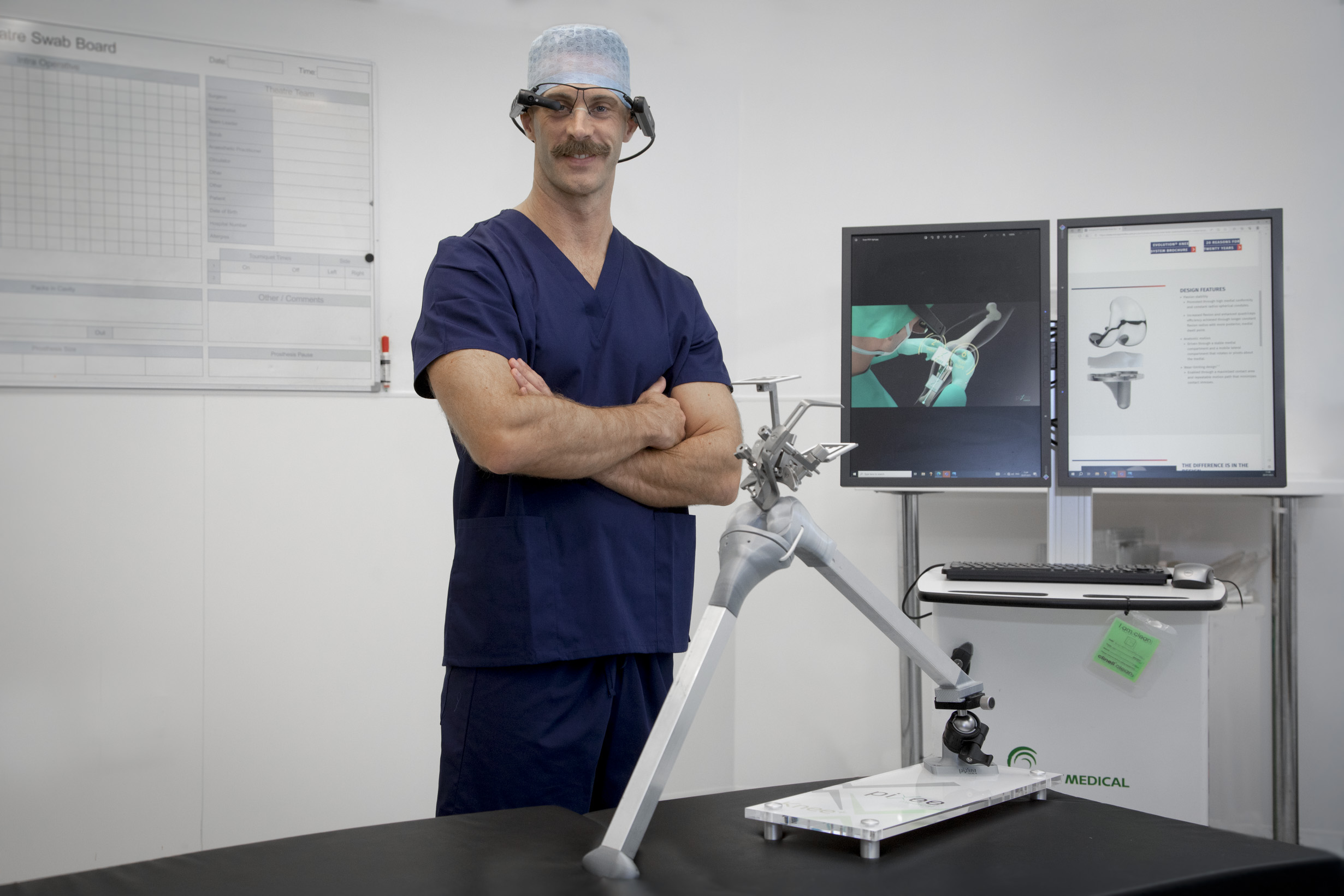
Spire Murrayfield Hospital Wirral has carried out what is believed to be the first UK revision of a partial to total knee replacement using augmented reality technology.
The procedure was performed by consultant hip and knee surgeon Alan Highcock using the Pixee Knee+ augmented reality system alongside MicroPort knee replacement technology.
The system projects real-time alignment information into smart glasses worn by the surgeon to support implant positioning during surgery.
Revision knee replacement procedures are typically more complex than primary knee replacements because of altered anatomy and existing implants.
Highcock (pictured) said: ‘Revision knee replacement surgery is among the most complex procedures we perform, and precision is critical.
‘Being able to use augmented reality technology on intact anatomical landmarks, in real time, allows us to visualise alignment and positioning with an added level of accuracy.
‘To perform the UK’s first revision of a partial to total knee replacement using Pixee AR is an exciting milestone, and one that ultimately supports better outcomes for patients undergoing challenging revision surgery.’
Traditional navigation systems for knee surgery can require additional imaging, invasive reference points or large hardware systems. The Pixee system instead uses a surgeon-controlled augmented reality platform.
A new UK study, conducted at Spire Murrayfield, and published in the Journal of Robotic Surgery examined the use of augmented reality-assisted knee replacement procedures at the hospital.
The study analysed 116 knee replacements performed by a single surgeon, including 39 procedures using augmented reality assistance and 77 using conventional techniques.
Researchers reported improved accuracy and consistency of femoral component alignment in the augmented reality-assisted procedures, alongside reduced blood loss and improved range of motion one year after surgery. The study also reported no increase in operating time.
 ©2026 All rights reserved LaingBuisson