

Iraq is one of the most important source markets of health and medical tourists to Iran. Saeed Hashemzadeh, manager of the health tourism office at the Ministry of Health and Medical Education of Iran and Niloufar A’alami, MBA, Health Tourism and employee of AriaMedTour, a large medical travel facilitator in Iran, surveys Iraq’s health tourism market and offers some suggestions.
Iran’s health tourism sector has developed and attracted many investors in recent years, thanks to the country’s highly regarded doctors, quality of service, low prices, cultural and climatic diversity, and natural hot springs [1]. With plenty of tourist attractions, it has the potential to be considered one of the leading destinations for health tourism in the world [3].
Iran’s 20-year vision document reflects this belief, stating “Iran should be the first region in the area for health tourism”. It anticipates that by 2025, 20 million international tourists will be entering the country [11].
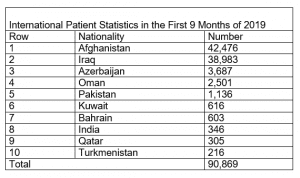
The most popular treatments attracting medical travellers to Iran in 2019 were for gynaecological diseases, eye surgery, orthopaedic surgery, heart disease, urology, nose surgery and non-surgical diseases [4]. Statistics from the Ministry of Health and Medical Education show the main sources of Iran’s international patients for the above-mentioned treatments [5]:
According to an official report from the Ministry of Health and Medical Education in Iran, the highest number of international patients went to Tehran, Mashhad, Qom, Shiraz, Ahvaz, Urmia, Tabriz and Semnan [4].
This reflects the mutual cultural factors that Muslim countries share, and may influence city selection, for example, those related to religion, customs and traditions, and common food interests [9].
However, illegal brokers in countries such as Iraq and Afghanistan are threatening the supply of health tourists to Iran, diverting them instead to other countries in the region [20].
Survey findings
To better understand the source market in Iraq, we undertook a detailed survey of Iraq’s health tourism market, using objective observations, field research, documentation and information assessment, based on 100 survey forms from three general hospitals (75 to 200 beds) and two limited surgery centers in Tehran.
We found that marketing to health travel consumers in Iraq is different from many neighbouring countries such as Oman, Qatar, and the United Arab Emirate, as the Iraqi’s main method in receiving health tourism marketing is traditional and offline.
The Iraqi patients’ priorities for choosing Iran are also driven first by price (70%), followed by perceived quality of health services (68%), offline promotion by trusted brokers (62%), and familiarity of the country (35%).
Iraq’s GDP survey estimates the average per capita income per person in this country is about US$3,600 [13]. 70 of the 100 Iraqi patients in the survey point out the affordable medical services price in Iran as the first factor of their medical trip to this country. Brokers in the Iraqi health tourism market are influential in the high level of choice of Iran and the corresponding city for the treatment.
How can Iran attract more Iraqi medical travellers?
Based on these findings, we recommend Iranian medical and health organisations consider the following:
- Respect the customs of all patients, including those from Iraq.
- A large part of the Iraqi medical and health tourism market is run by brokers, and this is mainly due to the dominant culture of trust in recommendations from both families and brokers. Against this background, it is suggested that hiring, training and issuance of cards approved by Iran’s Ministry of Heritage or private facilitator companies, can, in fact, help to organise the activities of the health tourism brokers in Iraq, who have been working unprofessionally in this market for many years.
- Paying enough attention to the culture of each country plays an important role in marketing and attracting customers. Considering that Iraq is a Muslim country, it is important to understand people’s religious beliefs during treatment. For example, the presence of female doctors for medical advice, treatment, and follow-up of patients in gynaecological diseases, infertility, cosmetic surgery for women should be considered.
- Inclusion of translators in hospitals and facilitator companies, who are fully acquainted with the culture and tradition of Iraqi people.
- Creation of contracts between hospitals and facilitator companies in Iran with Iraqi hospitals and medical centres, for direct patient referral by letter to special medical centres in Iran.
- Establishment of diagnostic clinics on the borders of Iraq and Iran, for primary diagnosis and direct referral of patients to specific medical centres.
- Establishment of facilitator companies offices in major Iraqi cities for marketing and direct attraction, without broker intervention.
- Attending Iraqi exhibitions, advertising in mass media such as television, using offline advertising tools such as brochures, catalogues etc.





 ©2026 All rights reserved LaingBuisson