
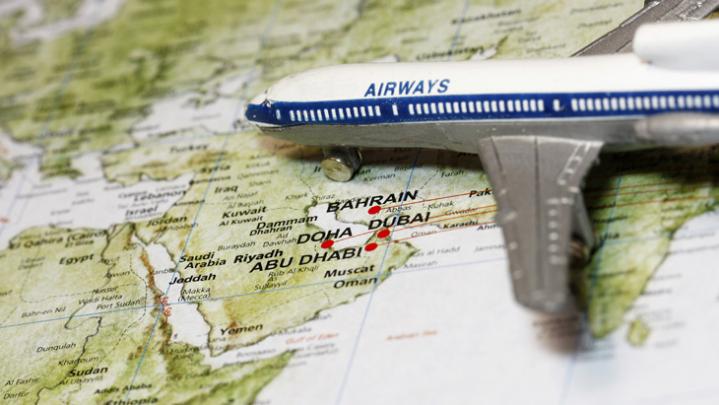
With oil price plummeting to an all time low, Ian Youngman from IMTJ drills down to discover the effect lower oil prices will have on medical tourism particularly the Middle East, the biggest supplier on the oil market.
On the face of it, cheaper oil should help medical tourism by cutting airline fares, but life is never that simple. Other rising costs means that we are unlikely to see substantial cuts in air ticket prices either now or in the future.
The much bigger impact is on the Middle East/ Gulf region where many states are dependent on oil revenue.
Oil was once $100 dollars a barrel and is now below $30 and prices could fall to $20 in 2016 and even $10 by 2017.
The scale of the fall
Oil prices have fallen to the lowest since 2003 – and by the time you read this, are almost certain to have fallen much further.
The USA has revoked sanctions that had slashed Iran’s oil exports by around 2 million barrels per day since its pre-sanctions 2011 peak to little more than 1 million bpd. It will take time for Iran to increase sales and production but this extra oil will drive prices lower during 2016.
A chronic global surplus of a million barrels or more of crude daily has pulled down oil prices by over 75% since mid-2014 and by over 25% since the start of 2016.
In the wake of falling prices, OPEC, led by Iraq and Saudi Arabia, has increased oil production and Russia’s output has also reached a post-Soviet era peak. As a consequence, global stockpiles have reached a record high.
Oil from the Gulf is facing competition from newer huge reserves across America and elsewhere.
Prices were falling to the lowest for many years but the recent political deal between the West and Iran puts Iran back as a major oil supplier.
Falling number of expatriate workers
As in the West, foreigners can sometimes get the blame for economic woes that they have no control over. There is a move to replace expatriate workers with locals and where this happens, local and overseas hospitals will find that business from expatriates on a self-pay or insured basis will fall.
There is a problem of localisation in that many overseas workers are in domestic service, industry, teaching, retail or other low level work with jobs that locals have not been prepared to do. But with an educated and young local workforce what is likely to happen is that locals who may not use local or overseas healthcare will replace the only expats that can afford private healthcare.
Replacing experienced overseas professionals with locals is a risk. Replacing low paid overseas workers with locals is a culture shock that citizens may eventually have to face, however much it hurts their pride and status as the state may no longer subsidise their food, heating, travel and living. Basically local workers who can work will no longer be allowed to be idle.
Impact of price falls on the economy
The effect on leading Gulf oil producers is about the same as if your annual income was suddenly cut by half or two thirds
Saudi Arabia leads the countries that have not been prepared to cut oil production to try to keep prices higher as they are desperate for oil revenue.
Low oil prices are already leading to a decline of exports and revenue, hurting public finances, undermining financial planning and ultimately threatening to expose often-insufficient diversification of the economy. Currency values against the US dollar are being questioned.
Unemployment or underemployment, especially among youth, is also of high concern in the region, with youth unemployment as high as 33% in Jordan and above 20% in Oman, Saudi Arabia, and Algeria. Informal employment is a growing trend, adding to the potential for the job market situation to fuel profound social instability – a risk that is exacerbated by a regional humanitarian crisis that sees neighbouring countries coping with refugees from Syria. One in four of the world’s refugees is now Syrian, with 95% located in surrounding countries; in Lebanon, over a fifth of the population is refugees.
Political tensions
The Gulf region is a political hot potato and some countries are suffering more than others. Tensions between Saudi Arabia and Iran, already fighting a proxy war in Yemen and backing opposing sides in the Syrian conflict, have reached new heights. Israel is furious with the USA for lifting sanctions on Iran.
The Saudi Kingdom faces a growing risk of destabilising discord within the royal family this year, and its increasingly isolated status will lead it to act more aggressively across the Middle East. The threat of intra-royal family strife is on the rise, and a scenario of open conflict, unimaginable prior to King Salman’s January 2015 ascension, has now become entirely realistic. The key source of external Saudi anxiety is Iran.
Cuts in public spending
Budget cuts impacting infrastructure spending across the Middle East on healthcare, welfare and social spending. States that have never taxed citizens have to find new ways of raising money from taxes and charge citizens for things that were once free.
Cuts include postponements to major infrastructure contracts and cancellations of new ones. This has not yet hit new hospital builds, as it can be nearly as expensive to stop a project than finish it.
While some of the cuts are public knowledge there is a huge loss of pride from countries that were once so rich they did not have to bother with budget problems that others faced. So what is actually happening, as opposed to what governments are admitting, is on a much larger scale.
Qatar’s recent sudden abandonment of state healthcare insurance for citizens, insurance, had much more to do with budget cuts than the claimed inability of the healthcare company to run the new system.
Oman’s government has lowered spending and slashed subsidies, as the sultanate is, one of the worst hit among the Gulf countries due to the oil price drop.
Saudi Arabia, the biggest economy in the Gulf Cooperation Council, has cut subsidies on oil, water, food, and electricity while the United Arab Emirates has slashed fuel subsidies.
Most Gulf governments are also reportedly looking to impose a sales tax by 2018 to bolster their non-oil income. Bahrain, Oman, Qatar, and Kuwait have recently adopted new policies to deal with the steep decline in the price of oil, the main source of their revenues.
The IMF has called on Gulf states to introduce taxes, trim spending, cut subsidies and introduce reforms to help balance their fiscal budgets and deal with the low oil price environment. The fund has warned that regional economies could use up their financial buffers within five years as they face a combined fiscal deficit exceeding $700 billion between 2015 and 2019. Gulf countries are expected to use their financial reserves as well as borrow money to finance their fiscal deficits.
According to the IMF, most Gulf countries are in denial- expecting oil prices to rise again soon, and not fully prepared to embrace the social and cultural changes or diversify quickly enough .The UAE is the most diversified economy while Bahrain and Oman are the most vulnerable, being the most oil dependent and the slowest to cut budgets or diversify.
Reductions in outbound medical tourism
While some states admit how many people they send overseas for medical treatment paid for by the state-others have been doing so and not admitting it for fear of damaging the reputation of local healthcare or a nascent medical tourism business.
How quickly and how far the price of oil drops may determine whether state paid overseas healthcare is just reduced or stopped completely.
Citizens of Gulf countries who will now have to pay direct and indirect taxes and higher prices for many local services, will have less money to take themselves and their entourage on long trips for minor treatment to expensive countries.
Effect on inbound medical tourism
Apart from Dubai and Jordan, the amount of medical tourism to most Gulf states is low or nil. Figures claimed by Dubai and Jordan may be misleading, one due to the high number of local expatriates that are counted as medical tourists when they are local international patients, the other due to many so called medical tourists being refugees or state paid patients from war countries.
Every other new healthcare facility seems to claim that it will be a destination for medical tourists, but even if this wishful thinking were true, the rising healthcare costs may kill or reduce what little business there is.
There will of course be people preying on these states to offer their paid for help by suggesting that inbound medical tourism could replace lost oil revenue. Most Gulf states are not set up for inbound business or can only offer high prices. The impact on lost revenue from medical tourism revenue would be the equivalent of pouring a glass of water on a fire at an oil terminal.
Conclusion
If your medical tourism business is in any way dependent on state funded or private patients from Gulf states, then the impact may not be sudden, but an “ever increasing pot of Gulf gold” is more likely to be a mirage than a reality.






 ©2026 All rights reserved LaingBuisson