

A decade ago, medical tourism was filled with hype. Editor in Chief, Keith Pollard, asks if much has changed in the intervening years.
Back in 2008, I wrote an article for IMTJ about the ‘medical tourism numbers game’. It highlighted the hyping of the industry and the continuing publication of exaggerated claims that misled entrepreneurs and investors as to the real potential of the medical tourism sector.
In the ten years since, have we made any progress? Is anyone able to say how big the sector is? How many people are travelling across borders for healthcare? And how much is that business worth?
Does it really matter, if we don’t know?
The challenges in measuring medical travel
At the core of the problem lies the definition of medical tourism… or is it medical travel? (My preference is for medical travel). Different interest groups have different ways of defining what the market consists of:
- Does it include health and wellness travel? For example, is a German who visits a spa in Hungary a medical tourist?
- Is a patient who crosses a national border (from the US to Mexico, or from Italy to Croatia for example) a medical traveller?
Because everyone defines medical travel differently, many of the claimed numbers don’t make any sense at all; we see massive variation in the figures quoted, even for individual countries.
If you thought defining medical travellers was difficult, try counting them. Here are just some of the areas of confusion in counting both numbers and values:
- Counting ‘accidental’ medical travelers (like business travelers and holiday makers who fall ill while abroad and are admitted to hospital)
- Counting expatriates who access healthcare in a foreign country
Counting the same patient on one visit numerous times over, by recording every interaction with a hospital
The hype continues
In 2014, we heard this from the US based Medical Tourism Association:
“An estimated 11 million health care consumers pumped US$438.6 billion into local and national economies overseas this year alone – that’s 14% of the world’s tourism dollars”.
If you do some basic maths, that works out at an average revenue per patient of US$40,000. Does that sound right to you, given that a significant amount of medical travel is driven by low cost destinations? How does this compare to the average revenue per medical tourist reported in Malaysia’s medical tourism sector? Or the average revenue per medical tourist reported by Bumrungrad Hospital in Thailand?
Sadly, these inflated numbers reappear on slides in conference presentations, in market reports and in media coverage. Fiction becomes fact.
What’s the real number?
The truth? No one really knows. At IMTJ, we monitor the figures published or claimed by countries, healthcare providers, associations and clusters across the globe and conduct a sanity check on those numbers. We then publish what we believe is the real number, for both inbound and outbound medical travel, in our IMTJ Country Profiles.
Recently, we undertook an analysis of the medical travel numbers in our IMTJ Country Profiles and attempted to create an IMTJ estimate of the size of the global market for medical travel.
This is what we found:
- Even when we adjust for the overclaims and mis-counting of numbers, we saw a significant discrepancy between our estimates of inbound and outbound numbers. The number of inbound medical travelers claimed by destinations is much higher (by a significant factor) than our estimates of the number of medical travelers leaving source countries. One million medical travelers that destinations claim to receive don’t appear to come from any other country
- Our best guesstimate of the number of medical travelers worldwide: around 5.5 million
- Our best guesstimate of the value of medical travel expenditure on treatment worldwide: around $10 million to $15 billion
Does it matter?
Yes, it does. If governments, healthcare providers are going to invest in promoting their medical travel destination, they need to measure the return on their investments. Investors and entrepreneurs targeting the sector want to know what the potential return may be, and whether their investment has paid off.
Is anyone getting it right?
The good news is that some countries are making a positive effort to measure the impact of medical travel.
- In the US, the US Cooperative for International Patient Programs(USCIPP) is tracking international patient throughput at its member hospitals. It calculates that around US$3.4 billion was spent by international patients in the US. That makes the US the number one medical travel destination by value in the world. Not Thailand or India as you might think if you believe what you read on the internet
- In Malaysia, the Malaysia Healthcare Travel Council(MHTC) gathers data from Malaysian hospitals who are required by law to submit data. Revenue from medical tourism was US$197.5 million in 2014, US$228.7 million in 2015 and in 2017 it is projected to pass US$254.1 million. The data incorporates all international patients including non-travelers (expatriates, holiday makers, business travelers) but MHTC is able to differentiate these numbers
In Korea, the Korea Health Industry Development Institute (KHIDI) has made significant efforts to measure the return on its investment in promoting Korea as an international patient destination. Data is collected from participating hospitals and clinics, compiled centrally and analysed by number and value both nationally and by region. International patient numbers have grown from 60,000 in 2009 to 364,000 in 2016. Professor Jin Ki Nam, from Yonsei University has measured the return on investment which KHIDI has made in promoting medical tourism. He estimates that in 2015, the Seoul/Gangseo-gu region delivered a return of US$101 in patient income for each dollar invested by the central and provincial government
Where do we go from here?
Subscribe to IMTJ and you might get some sensible answers to these questions about the size and value of medical travel. Come to an IMTJ event and you’ll get the real picture of where the industry is going. Buy an IMTJ report and you’ll see how we unpick the hype and exaggeration and tell you what we do and what we don’t know about the industry.
As a market sector (or is it an industry, a business or just a series of disparate market niches?), we need to do much more to measure market size, both globally and within individual destinations. At LaingBuisson, we are the approved provider of statistics on the UK’s independent sector to the UK government’s Office of National Statistics. Perhaps, we could help to improve how your destination counts and measures medical travel.
The top 25 medical travel destinations by value:
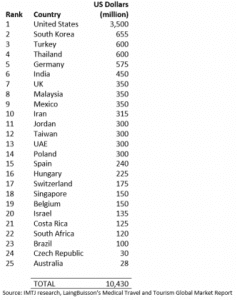
How did we compile this table?
IMTJ has analysed the published and claimed data for each of these destinations. For some, we can make a fairly accurate estimate, as data is collected in a semi-rigorous way by a government body. For others, the number is our ‘best guesstimate’.
We have excluded:
- Health, wellness and spa travelers
- Expatriates, foreign residents and ‘accidental medical tourists’ (those who fall ill on business or vacation trips)
Expenditure on non-medical services
We have adjusted data where there is clear exaggeration of patient throughput, or where there is wide inconsistency in claimed figures.
Is it accurate?
It’s as good as it gets! Use this data with care… as a guide not as reality. For some countries, where there is multiple counting of patient visits rather than unique patients, there may still be inflation of the figures. For some countries where there is no independent measurement of value or numbers, your guess may be as good as ours.
For a greater understanding of how these numbers have been estimated and how they compare with claimed numbers, we suggest you buy an IMTJ Country Subscription.
How big is the global market?
If we apply the 80/20 rule, that these 25 leading destinations account for around 80% of the market, then the global market is worth around US$13 billion, consisting of approximately 5.5 million medical travelers, with an average spend per patient of US$2,450.






 ©2026 All rights reserved LaingBuisson