

International health travel by patients has been impacted greatly by the pandemic of 2020, but there is cause for optimism. Professor David Vequist, founder and Director of the Center for Medical Tourism Research (CMTR), summarises some of the centre’s ongoing research in medical travel in a post pandemic world and finds cause for optimism.
It appears that medical tourism, in a post pandemic world, will be mostly positively impacted by the four following trends:
Pent up demand
Medical tourism is intimately correlated with tourism and travel. Two studies by the CMTR have suggested that medical travellers would also engage in tourism activities as part of a trip abroad. The first survey, of 2,000 potential American medical travellers in 2011, found that 78% would consider tourism activities while abroad. The second study in 2015 found that 68% of Latin American medical travellers to the USA engaged in tourism activities.
So what does all this pent-up demand look like in the tourism space?
It has been termed by one publication the ‘vaxication’ and in another ‘rebound travel.’ Several experts and articles over recent months have suggested that certain types of travellers are planning on travelling sooner than later. These include affluent travellers and young adults. The international affluent travellers, according to Strategic Vision (2020), are showing “keen interest in safaris, European vacations and far-flung destinations – if not in the immediate term, then in the near future.” GenZ and Millennial generations around the world are also planning to travel again soon. According to a survey by Bloom Consulting (2020) 93% of young adults say that the pandemic and lockdowns have increased their desire to travel and 75% of these future vacationers plan to take longer trips and go farther away from home (also 81% want something different from standard holiday destination fare).
When will this pent up travel demand begin to grow? It appears that luxury travellers (Travel Pulse) and young people (Euro News) are still being careful and are following the reports about vaccines and the spread of the virus. As per the Bloom survey, about 35-45% of possible travellers suggest that they probably won’t travel again until the virus is under control and a smaller group (15%) claimed they would not travel again until the virus is completely contained. The European Travel Commission (2021) found in a study of domestic and intra-European travel that “32% of respondents indicated that they intend to take a trip during April-June 2021” and over half of Europeans plan to travel somewhere after June 2021. The biggest source of tourists (post-pandemic) will be China (the China Outbound Tourism Research Institute [COTRI] is forecasting 100 million international trips in 2021) and second will be Americans (Skift, 2020) which “will see much lower outbound numbers especially in the first half of 2021.”
The pent-up demand for medical procedures that were either delayed or cancelled during the pandemic will also play a key role in the increase in medical tourism in 2021.
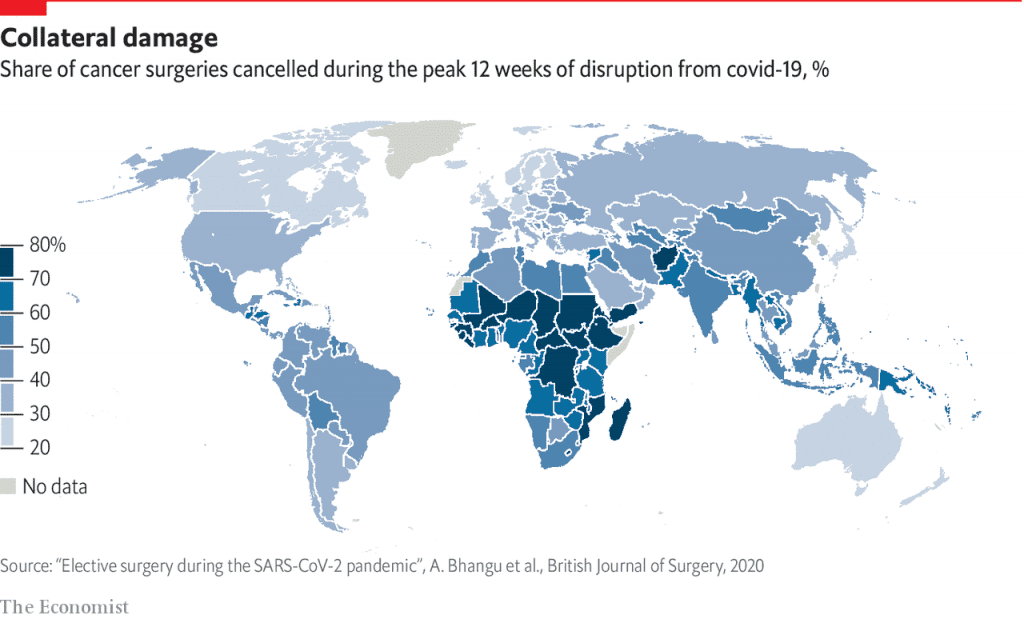
For example, research by the CMTR in the New York Times (2021) suggests that in the U.S. alone almost 178,000 surgeries were delayed or disallowed because of government regulations. Keith Pollard, IMTJ Editor in Chief, reported in December 2020 that in the UK, “the number of NHS patients waiting for more than a year for surgery has gone from 1,032 to 83,203 in 12 months.” Deloitte (2020) highlights that in France, consultations fell by 40% among GPs and 50% among specialists since the beginning of the epidemic. The Lancet (2021) also found that over 3,500 fewer people had been diagnosed and treated for colorectal cancer in England than would have been expected in 2020. Finally, the Economist (2020) suggests that worldwide tens of millions of surgeries were postponed and it would take many months to work through the backlog (see graphic below).
Therefore, between both long delayed travel plans and pent-up demand for healthcare it seems very likely that medical travel will pick up in mid to late 2021 (assuming no further disruptions!).
Immigration / Migration
The second factor that seems to have been fuelling demand for healthcare tourism over the last decade has been the movement of people across borders.
Whether due to regional conflicts or seeking better economic conditions, these migratory flows have had an oversized impact on international healthcare. In a pair of recent academic papers by Jang (2018 and 2017), she found that 17% of immigrants received medical care in a foreign country and that around one-fourth of migrants ended up travelling back to their home country for medical care (evidence from Koreans in the U.S.A.). These global citizens who have found their way to new destinations typically access medical care in what has been termed ‘healthcare bricolage’ or the “creative mobilisation, use and re-use, of wide-ranging resources, including various knowledge resources, and multiple ideas, materials and networks in order to address particular health concerns” (Phillimore & et al., 2019). This trend then obviously involves travel both domestically and internationally and fuels additional inbound/outbound medical tourism.
Value-Based Care / Narrow Networks / Centres of Excellence
According to the New England Journal of Medicine (2020), started as a typically American idea (and based on Harvard Professor Porter’s book ‘Redefining Healthcare’) the concept of Value Based Healthcare (VBHC) has been moving away from fee-for-service models and instead emphasises “coordinating patient care among providers and creating outcome platforms to drive quality improvement and appropriateness of care.”
This trend of narrowing networks of providers to the best facilities, termed Centres of Excellence (CoE), has gained momentum over the last decade and is driving demand for domestic medical tourism by employers (for employees) in countries like the USA, and for international healthcare tourism by government reimbursements (for citizens) in regions like the Middle East. Most medical travellers are looking for access to the best procedure and at the most affordable price they can pay – and consequently these tend to be found at CoEs. As competition for this high distinction continues to drive higher value in healthcare, it will be the consumers/patients that ultimately benefit in 2021 and beyond.
Wellness Travel and Mental Health Travel
The pandemic has brought with it a steady crush of bad news for many around the world. According to a 2021 World Economic Forum report, a survey by McKinsey, showed “62% of employees globally consider mental health issues to be a top challenge during the COVID-19 crisis.”
There have been many additional articles since late last year that stated that increasing wellness, getting in better shape, repairing mental health, and strengthening the immune systems is a key personal goal. A Forbes (2021) article states that “we have become increasingly conscious about our personal health and wellbeing” and are anxious to find destinations to assist with this.
Planning to meet this need, several wellness tourism destinations are advertising “immunity boosting wellness retreats” such as the Amanpuri resort in Thailand which offers an Immune System Support treatment or the spa Chablé Maroma, on Mexico’s Riviera Maya, which offers tailored wellness programmes providing better chances to fight off illness and combat the long-term effects of coronavirus. Since stress-related burnout and increasing anxiety became an issue due to the pandemic, these facilities are hoping to help their clients find mindfulness, balance and mental peace in the near, post COVID-19, term.
The up-coming year does appear fruitful for medical travel and the pre-pandemic growth that most providers were seeing should return again soon. If estimates of tourism-related travel are correct, then ‘normalcy’ could begin to return as soon as the second half of 2021. However, the future of medical tourism will continue to be linked with the issues surrounding the worldwide pandemic of 2020 for some time to come.






 ©2026 All rights reserved LaingBuisson